
Star Trackers & Long Exposures: How to Turn the Earth Off
The fundamental challenge of astrophotography is the Earth's rotation. To capture sharp, deep-sky images, we must synchronize our gear with the moving stars. This dossier recalibrates your workflow for star tracker deployment, from perfect polar alignment to long-exposure acquisition.
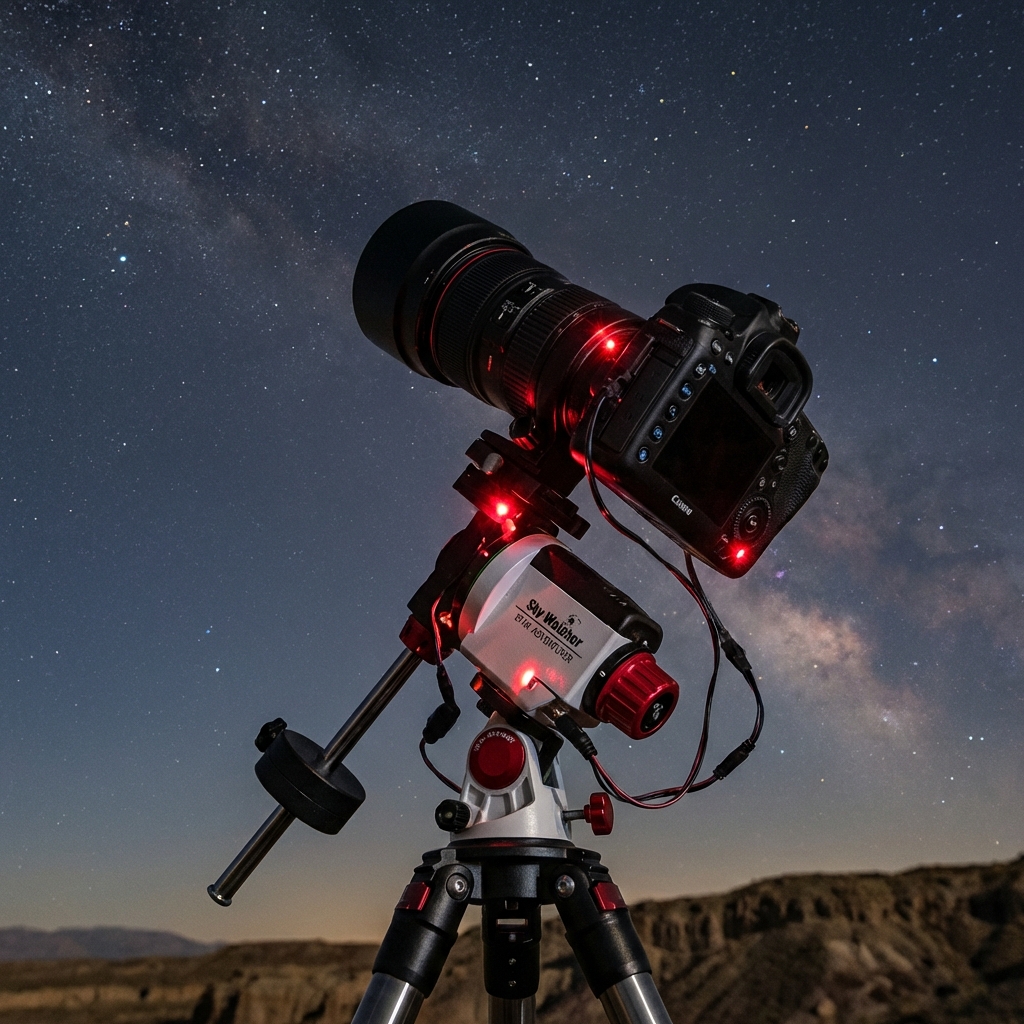

DH Research Lab
Data & Editorial Board
Expert Tested Gear & Affiliate Disclosure
This guide contains affiliate links. As an Amazon Associate, we earn from qualifying purchases.
01The Physics of Light Collection
Why does a tracker matter? It's simple math.
Untracked (Static Tripod): You are limited by the NPF Rule or 500 Rule. With a 50mm lens, you might get 8 seconds before stars streak. You have to crank your ISO to 3200 or 6400, adding noise.
Tracked: With a tracker, you can shoot that same 50mm lens for 120 seconds.
- You capture 15x more light per frame.
- You can drop ISO to 800 or 1600 (less noise).
- You can stop down the aperture (e.g., f/2.8 to f/4) for sharper stars.
Exposure Time
Go from 15 seconds to 300+ seconds.
ISO
Shoot at lower ISO (800-1600) for cleaner images.
Detail
Reach faint nebulae invisible to short exposures.
02Equipment: Choosing a Tracker
There are two main categories of portable star trackers:
1. The Ultra-Portable (Mechanical or Basic Electric) Example: Move Shoot Move (MSM) Rotator
- Pros: Tiny, fits in a jacket pocket, quick setup.
- Cons: Less accurate for focal lengths over 50mm.
- Best For: Wide-angle milky way landscapes.
2. The Astrophotography Workhorse Example: Sky-Watcher Star Adventurer GTi
- Pros: GoTo capability (finds targets for you), handles 300-400mm lenses, built-in guiding port.
- Cons: Larger, heavier, needs a counterweight.
- Best For: Deep sky imaging with telephoto lenses.
Sky-Watcher Star Adventurer GTi
“The gold standard for portable deep-sky imaging.”
RATIONALE
It has GoTo. You verify alignment on your phone, tell it to 'Go to Andromeda', and it slews right there. Game changer.
03Polar Alignment: The Critical Step
A tracker only works if its axis is perfectly parallel to Earth's axis.
Northern Hemisphere: You align to Polaris (the North Star). It's not exactly at the pole, so you use the tracker's polar scope clock face to offset it correctly.
Southern Hemisphere: You align to... nothing. There is no south star. You have to triangulate using the Sigma Octantis constellation (which is incredibly faint). Pro Tip: Use a digital inclinometer or a "polemaster" camera to assist if you can't see the pole stars.
04Settings for Tracked Shots
Once you are tracking, your settings change completely from static shooting.
- Mode: Bulb
- Aperture: Stop down one click (e.g., f/1.8 -> f/2.2) for sharpness. You have the time now!
- ISO: 800 to 1600 (ISO Invariance sweet spot for most sensors).
- Shutter: 60s to 120s (use an intervalometer).
Check your Histogram: You want the "mountain" of data to be roughly 1/3rd from the left. Not crushing the blacks, but not blown out.
Don't waste a clear-night chance
Get the field checklist, then use DarkestHour to decide if tonight's sky is actually worth your time, setup or travel.
Learn first. Decide with the map.
DarkestHour guides are free trust builders. Use them to understand conditions, then use Pro for saved spots, alerts and best-night decisions.
Find Your Darkest Sky
Use our real-time satellite maps to find locations with zero light pollution.
Launch Interactive MapYour Learning Roadmap
You've mastered the astrophotography basics. The next logical step in your technical progression is mastering astrophotography workflows.
MANDATORY FIELD EQUIPMENT
Celestron NexStar 8SE
The gold standard for deep-sky observation. 203mm aperture for maximum light gathering.
ZWO Seestar S50
Fully robotic imaging system. Perfect for urban environments and rapid deployment.
Peak Design Travel Tripod
Zero-latency stability for long exposure astrophotography. Carbon fiber construction.
Continue Your Research
Dwarf III Review: The Ultimate Pocket-Sized Smart Telescope
Tiny but powerful. Discover why the Dwarf III is the best travel telescope for wide-field astrophotography and wildlife spotting.
Astrophotography Time-lapses: The Egg Timer Hack
Create mesmerizing motion videos of the night sky. Includes the $10 'Egg Timer' panning technique and day-to-night transition tips.
The Smart Telescope Revolution: Seestar, Origin, & Dwarf 3
Robots are taking over astrophotography. Compare the best smart telescopes of 2026: Seestar S50 vs Celestron Origin vs Dwarf 3.
End of Dossier • Research Complete