
How to Manage Satellite Trails in Astrophotography (2026 Guide)
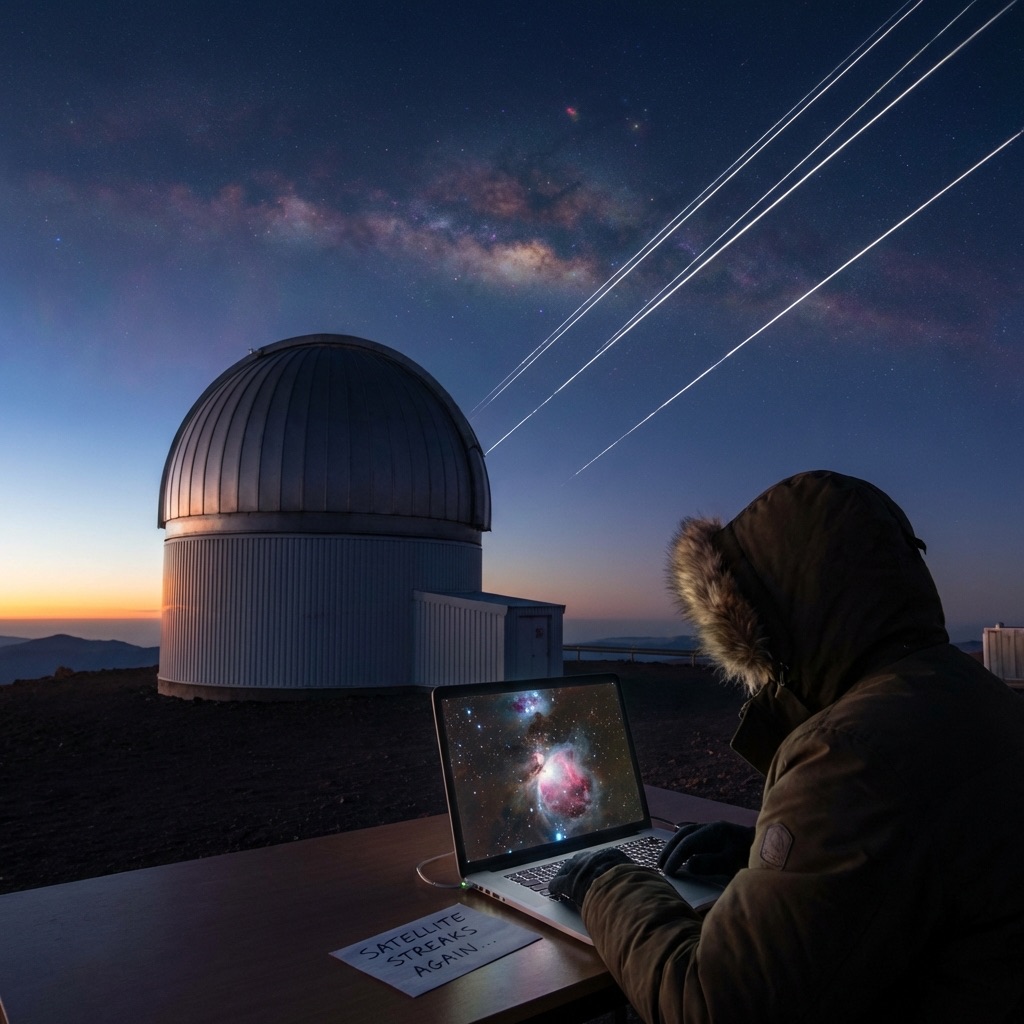
In 2026, the night sky is more crowded than ever. With thousands of low-earth orbit satellites now in operation, 'photobombing' has become a standard challenge for astrophotographers. However, satellite trails don't have to be a 'data killer'. With modern stacking algorithms and strategic shooting, you can capture pristine deep-sky images even in the age of Mega-Constellations.

DH Research Lab
Data & Editorial Board
Expert Tested Gear & Affiliate Disclosure
This guide contains affiliate links. As an Amazon Associate, we earn from qualifying purchases.
01The Reality of a Crowded Sky
If you take a long exposure of a popular target like the Orion Nebula(M42) or the Pleiades(M45), there is effectively a 100 % chance that at least one satellite will cross your frame.
The good news ? A single satellite trail contains a very small amount of energy compared to the hours of signal you are collecting.While a single frame might look "ruined," the collective dataset remains healthy.The key is shifting your mindset from "preserving every frame" to "curating a robust dataset."
02The Magic of Sigma-Clipping
The primary tool for erasing satellites is mathematical, not manual.Modern stacking software(PixInsight, DeepSkyStacker, AstroPixelProcessor) uses a technique called ** Sigma - Clipping **.
** How it Works:** 1. The software aligns all your frames. 2. It looks at a specific pixel(e.g., Pixel[500, 500]) across 50 different frames. 3. It calculates the average brightness(and the standard deviation, or 'Sigma') for that pixel. 4. If one frame has a pixel that is 3 + standard deviations brighter than the others(a satellite trail), the software "clips" or ignores that pixel for that specific frame. 5. The result is a clean stack where only the consistent signal(the nebula) remains.
Minimum Frame Count
03Shooting Strategies: Dithering
To help the stacking software even more, you should use a technique called ** Dithering **.
Dithering involves slightly shifting the camera position(usually by a few pixels) between every shot or every few shots.
** Why Dither ?**
- ** Fixed Pattern Noise:** It prevents "walking noise" by ensuring that sensor defects don't stay on the same part of the image.
- ** Trail Rejection:** By shifting the background stars relative to the sensor, you make it even easier for rejection algorithms to spot "transient" light like satellite trails that don't move with the stars.
04Sub-Exposure Optimization
In the past, many photographers favored very long exposures (e.g., 10 minutes). Today, the "Short and Many" approach is superior for satellite management.
By shooting 2-minute "subs" instead of 10-minute ones, a single satellite crossing only affects a tiny fraction of your total exposure time. If a satellite ruins a 10-minute shot, you've lost 10 minutes of integration. If it crosses a 2-minute shot, the impact is negligible and easily handled by sigma-clipping.
05Experience the Ultimate Mobile Observatory
Many of the best dark sky sites are in remote locations with zero cellular coverage. For the modern remote astronomer, Starlink has become an essential tool for live-streaming sessions, checking real-time weather, or managing remote rigs.
Frequently Asked Questions
Q:Does sigma-clipping degrade my image quality?
No. In fact, by removing outliers like satellites and cosmic ray strikes, it significantly improves the Signal-to-Noise Ratio (SNR) of your final image.
Q:Can I remove satellite trails from a single exposure?
It is extremely difficult to do so without leaving artifacts. Modern AI-based 'content-aware fill' can help, but it often smudges fine detail. Stacking multiple frames is always the preferred method.
Q:Is Starlink the only satellite constellation affecting us?
No, many companies (OneWeb, Amazon Kuiper) are launching similar constellations. However, Starlink is currently the most prominent due to its sheer scale.
Don't waste a clear-night chance
Get the field checklist, then use DarkestHour to decide if tonight's sky is actually worth your time, setup or travel.
Learn first. Decide with the map.
DarkestHour guides are free trust builders. Use them to understand conditions, then use Pro for saved spots, alerts and best-night decisions.
Find Your Darkest Sky
Use our real-time satellite maps to find locations with zero light pollution.
Launch Interactive MapYour Learning Roadmap
You've mastered the astrophotography basics. The next logical step in your technical progression is mastering astrophotography workflows.
MANDATORY FIELD EQUIPMENT
Celestron NexStar 8SE
The gold standard for deep-sky observation. 203mm aperture for maximum light gathering.
ZWO Seestar S50
Fully robotic imaging system. Perfect for urban environments and rapid deployment.
Peak Design Travel Tripod
Zero-latency stability for long exposure astrophotography. Carbon fiber construction.
Continue Your Research
Dwarf III Review: The Ultimate Pocket-Sized Smart Telescope
Tiny but powerful. Discover why the Dwarf III is the best travel telescope for wide-field astrophotography and wildlife spotting.
Star Trackers & Long Exposures: How to Turn the Earth Off
Why a star tracker is the biggest upgrade for astrophotography. We cover polar alignment, NPF rule vs tracked, and recommended gear.
Astrophotography Time-lapses: The Egg Timer Hack
Create mesmerizing motion videos of the night sky. Includes the $10 'Egg Timer' panning technique and day-to-night transition tips.
End of Dossier • Research Complete