
Where to Go Stargazing in Munich: Top Dark Sky Spots
Stargazing around Munich requires a bit of planning. To see the Milky Way or faint meteor showers, you have to escape the city's luminous footprint. We've compiled the ultimate list of dark sky escapes in the area.
DH Research Lab
Data & Editorial Board
Expert Tested Gear & Affiliate Disclosure
This guide contains affiliate links. As an Amazon Associate, we earn from qualifying purchases.
01Understanding Local Light Pollution
Before heading out from Munich, always check the Bortle scale of your destination. The transition from the inner city (Bortle 8/9) to these locations represents a massive leap in visibility.
02The Alpine Advantage
Why the Alps are a premier destination for European astronomers:
Atmospheric Stability: High-altitude sites are above the densest and most turbulent layers of air, leading to excellent 'seeing'. Mist Protection: Frequently, clouds and light pollution are trapped in the valleys (Inversion), leaving the summits in pristine darkness under a sea of clouds. Horizontal Distance: The rugged terrain naturally restricts the reach of urban light domes.
Bortle Scale
031. Berchtesgaden National Park
Distance from Munich: 1.5 - 2 hours | Bortle Class: 3 | Best For: Wilderness, lakes, dramatic peaks
Berchtesgaden is Germany's only alpine national park and is currently on the path to becoming a Dark Sky Park.
Top Viewing Spots:
- Königssee — Mirror-like water and sheer mountain walls
- Rossfeld Panorama Road — High elevation (1,500m+) accessible by car with 360-degree views
- Hintersee — Minimal light pollution and iconic 'Magic Forest' surroundings
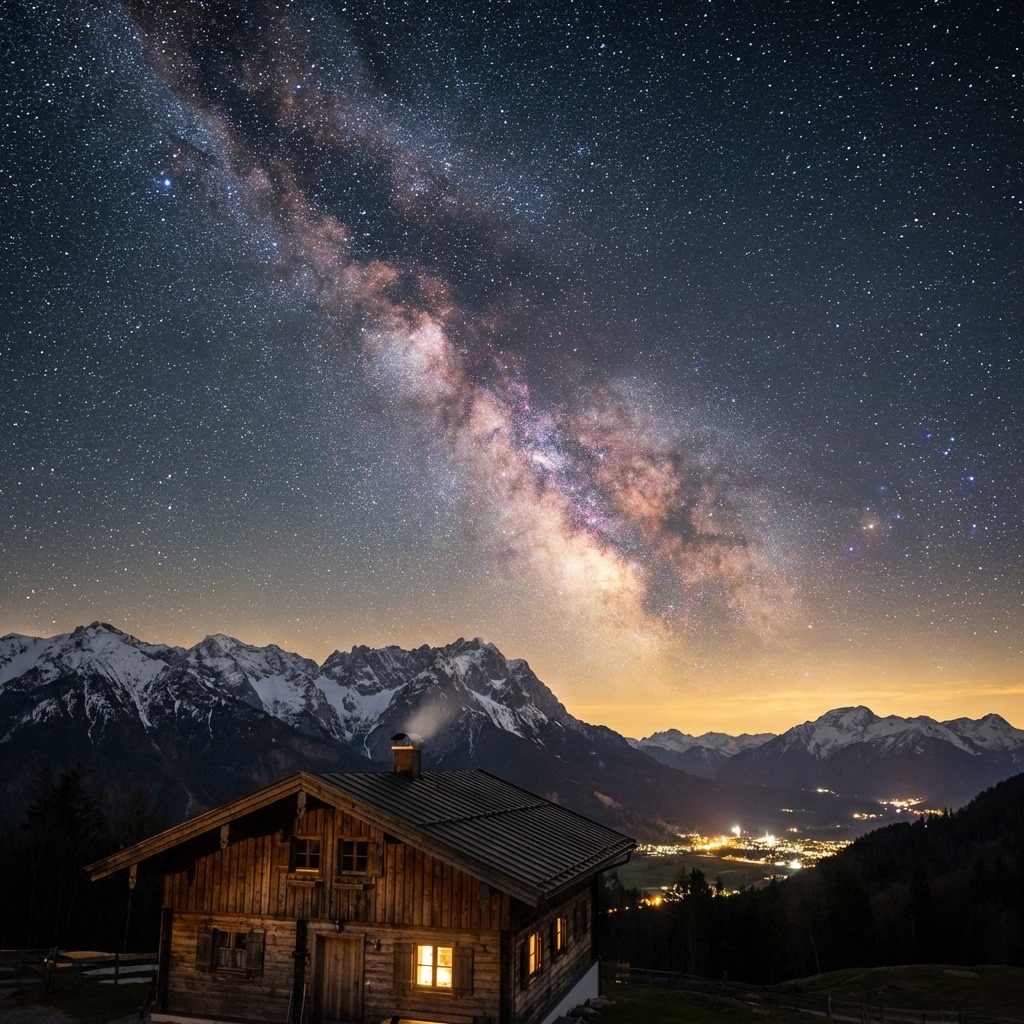
Image Tip: The Milky Way arcing between the Watzmann peaks, reflected in the still waters of the Königssee.
Stay22 - Berchtesgaden Alpine Chalets
“Find high-altitude stays in Berchtesgaden.”
RATIONALE
Staying at a mountain hut or high-altitude gîte allows you to step out directly into the dark.
042. Wendelstein Observatory (Brannenburg)
Distance from Munich: 1 hour | Bortle Class: 4 | Best For: Science combined with stunning views
The Wendelstein is home to one of Germany's most important research telescopes. While primarily for scientists, the summit is accessible and offers incredible stargazing.
Why go:
- Summit height of 1,838m puts you above the Munich light dome
- Accessible via the Wendelstein rack railway or cable car
- Regular public 'star tours' during the summer months
Bushnell Legend L-Series 10x42 Binoculars
“Rugged, high-clarity binoculars for alpine use.”
RATIONALE
Alpine conditions are tough. These binoculars are waterproof and offer the contrast needed to see deep into the galactic core from the peaks.
053. Karwendel Nature Park (Mittenwald)
Distance from Munich: 1.5 hours | Bortle Class: 3-4 | Best For: High-altitude plateau observing
The Karwendel is the largest nature park in the Eastern Alps. Its rugged limestone peaks protect deep, dark valleys.
Top Locations:
- Kranzberg — Dedicated 'Sternenpark' initiative with telescope pads
- Isar Valley — Dark riverbanks with minimal light pollution
- Karwendelbahn Summit — Extreme elevation for the best possible clarity
Rugged
Massive rock walls block light from Garmisch and Innsbruck.
Transparency
The dry mountain air makes the stars noticeably brighter than in the lowlands.
Summit Cold
Temperatures drop rapidly at 2,000m+. Bring heated gear even in summer.
064. Winklmoos-Alm (Certified Dark Sky Park)
Distance from Munich: 1 hour 15 mins | Bortle Class: 3 | Best For: First certified Dark Sky Park in the Alps
A high-altitude meadow (Alm) that was the first in the Alps to receive IDA certification. It's a gold standard for accessibility and darkness.
Why go:
- Dedicated 'stargazing loungers' for comfortable viewing
- Guided astronomy walks with local experts
- Perfect for families due to the gentle terrain
Dark Sky Loungers
075. Walchensee (The Bavarian Caribbean)
Distance from Munich: 1 hour | Bortle Class: 4 | Best For: Deep water reflections and mountain silhouettes
The Walchensee is one of the deepest alpine lakes. Its location in a deep basin means the surrounding mountains act as a natural shield.
Where to go:
- Zwergern Peninsula — Darkest part of the lake shore
- Herzogstand Summit — Reachable by cable car for an incredible overlooking view
Close by
An easy evening drive from Munich.
Silent
Motorboats are prohibited, making it a place of total acoustic and visual peace.
Accessible
The drive down the 'Kesselberg' road is a scenic treat in itself.
086. Großglockner High Alpine Road (Austria)
Distance from Munich: 2.5 hours | Bortle Class: 2 | Best For: The ultimate European mountain stargazing
If you are willing to cross the border, the High Alpine Road puts you at nearly 2,500m elevation in the heart of the Hohe Tauern National Park.
Sony Alpha a7 IV
“The best all-round camera for alpine landscapes and stars.”
RATIONALE
Alpine weather changes fast. The a7 IV has the weather sealing and low-light performance to handle sudden mists and freezing temperatures.
Don't waste a clear-night chance
Get the field checklist, then use DarkestHour to decide if tonight's sky is actually worth your time, setup or travel.
Learn first. Decide with the map.
DarkestHour guides are free trust builders. Use them to understand conditions, then use Pro for saved spots, alerts and best-night decisions.
Find Your Darkest Sky
Use our real-time satellite maps to find locations with zero light pollution.
Launch Interactive MapPlan Your Deployment
Ready to experience these dark skies yourself? Use our interactive map to find the best dark-sky certified hotels, desert cabins, and observatories near this location.
Booking through this map supports Darkest Hour's light pollution research.
Your Learning Roadmap
You've mastered the guide basics. The next logical step in your technical progression is mastering astrophotography workflows.
MANDATORY FIELD EQUIPMENT
Celestron NexStar 8SE
The gold standard for deep-sky observation. 203mm aperture for maximum light gathering.
ZWO Seestar S50
Fully robotic imaging system. Perfect for urban environments and rapid deployment.
Peak Design Travel Tripod
Zero-latency stability for long exposure astrophotography. Carbon fiber construction.
Continue Your Research
Your First Night Stargazing: Complete 2026 Guide
Everything you need for your first night under the stars. Learn to find dark sky locations, navigate constellations, and master stargazing with zero gear.
Astrophotography on a Budget: Milky Way for Under $500
Learn to photograph the night sky with affordable equipment. Our complete gear guide shows you how to capture the Milky Way for under $500.
Meteor Shower Calendar 2026: Don't Miss These Events
Your complete guide to every major meteor shower in 2026. Find peak dates, hourly rates (ZHR), and expert photography tips for each event.
End of Dossier • Research Complete