Finding Stars Near Melbourne: Top Observing Spots
Finding a truly dark sky near Melbourne can feel impossible with the ever-growing light dome. However, if you know where to drive, there are still pristine pockets of darkness waiting to be explored.
DH Research Lab
Data & Editorial Board
Expert Tested Gear & Affiliate Disclosure
This guide contains affiliate links. As an Amazon Associate, we earn from qualifying purchases.
01When to Leave the City
The key to stargazing near Melbourne is timing the weather. Allow at least an hour of driving time past the suburban perimeter to let your eyes adjust to the dropping light pollution.
02Victoria's Night Sky Strategy
Navigating the night in Victoria requires balancing coastal weather with inland darkness:
The Coastal Rain Shadow: The Otways and the Great Dividing Range can trap clouds. Heading inland often rewards you with much more stable and clearer skies.
Aurora Australis: While rare, Victoria's southern coast is one of the best places on the Australian mainland to see the Southern Lights during strong solar storms.
Salt Flat Reflections: Victoria's salt lakes offer a unique 'mirror' effect during the right conditions, doubling the number of stars in your view.
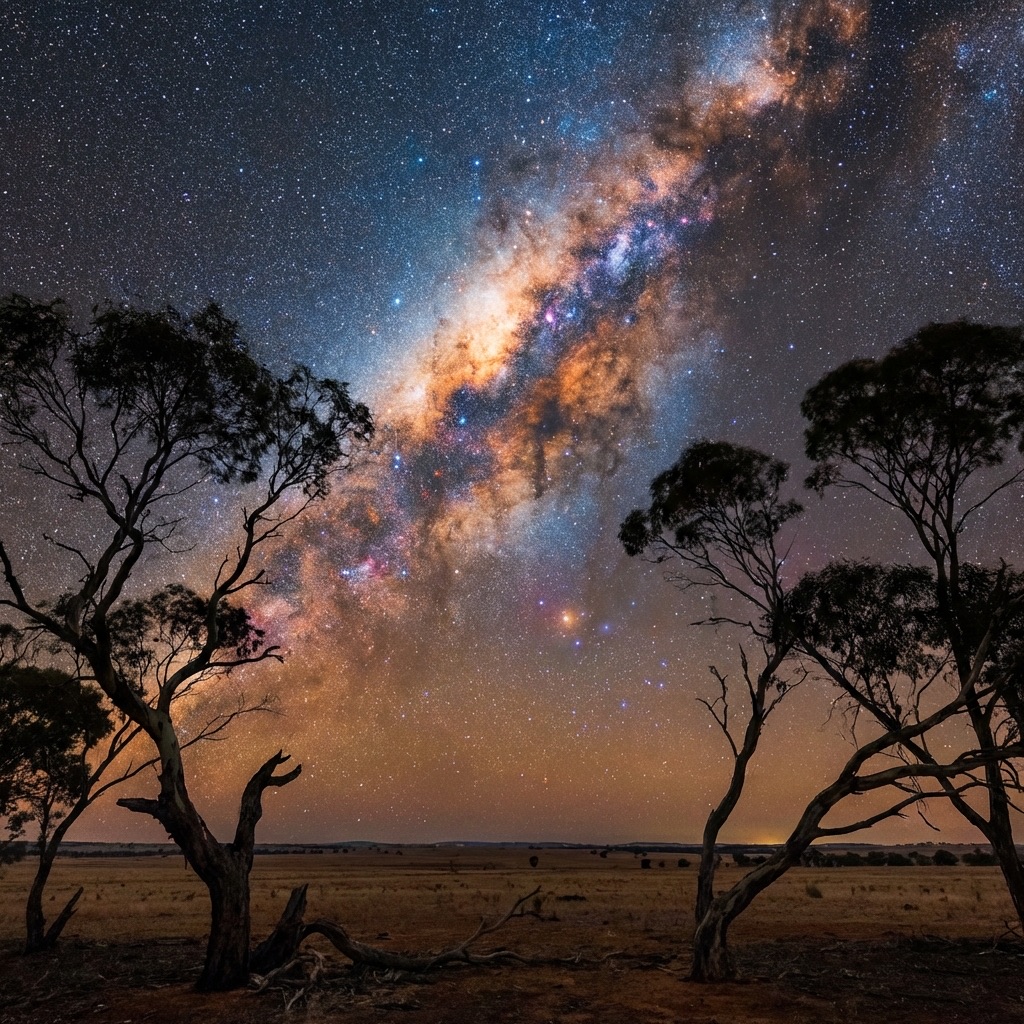
Image Tip: The Milky Way arcing over the Twelve Apostles, with the constellations of the deep south reflected in the breaking surf.
Bortle Scale
031. The Great Ocean Road (Twelve Apostles Area)
Distance from Melbourne: 3 hours | Bortle Class: 3-4 | Best For: Iconic sea stack foregrounds, ocean horizons
The Twelve Apostles aren't just for sunset. At night, looking south over the Southern Ocean means zero light pollution between you and Antarctica.
Top Viewing Spots:
- Gibson Steps — Best for beach-level views of the limestone stacks
- Loch Ard Gorge — Dramatic canyon-like foregrounds
- Cape Otway Lightstation — Historic lighthouse under the stars
Aurora Tip: This is a prime location to look for the Aurora Australis. Looking south over the ocean gives you an unobstructed view of the southern horizon.
Sony Alpha a7 IV
“Excellent all-rounder for low-light night photography.”
RATIONALE
The Southern Ocean coast is dynamic. This camera's autofocus and low-light sensor help you capture the surf and the stars simultaneously.
042. Grampians (Gariwerd) National Park
Distance from Melbourne: 3 hours | Bortle Class: 2-3 | Best For: Rugged mountain silhouettes
The Grampians feature dramatic sandstone ridges that provide perfect silhouettes against the night sky. The park is vast enough to offer genuinely dark, Bortle 2 conditions.
Where to Go:
- Reed Lookout — Easy access with sweeping views over the Victoria Valley
- The Balconies — Iconic 'Jaws of Death' rock formations
- Lake Bellfield — Dark skies with mountain reflections in the water
Pro Tip: Halls Gap can have some light; drive 10-15 minutes into the park interior for the best results.
Rugged
Stunning geological formations make for unique astro-compositions.
Silhouettes
The sharp ridges of the Grampians are unmistakable against a starry sky.
Elevation
Multiple lookouts put you above some of the valley haze.
053. Lake Tyrrell (The Mallee)
Distance from Melbourne: 4.5 hours | Bortle Class: 1-2 | Best For: Mirror reflections, extreme flat horizons
Lake Tyrrell is a shallow salt lake that has become world-famous for its reflections. When there is a thin layer of water, the lake perfectly mirrors the stars.
The Experience:
- Absolute flat horizons (360-degree views)
- Truly dark, Bortle 1/2 skies in the heart of the Mallee
- Unique boardwalk and viewing platforms for visitors
Note: The lake is often dry in summer. Visit in winter or early spring for the best chance of water reflections.
Water Levels
064. Wilsons Promontory National Park
Distance from Melbourne: 3 hours | Bortle Class: 3 | Best For: Southernmost point of the mainland
'The Prom' offers pristine coastal wilderness. With the ocean on three sides, it's one of the best locations for looking south toward the galactic center or hunting the aurora.
Where to Go:
- Squeaky Beach — Ultra-white sand and dark ocean horizons
- Mount Oberon Summit — A 1-hour hike, but the 360-degree views are unrivaled
- Tidal River — Good access if you are staying in the park
Wildlife: Wombats and kangaroos are extremely active at night. Drive very slowly inside the park.
Southern Edge
The closest you can get to the Southern Pole from the mainland.
Wilderness
A genuine sense of isolation and pristine nature.
Dark Horizons
Zero light dome when looking out over the Bass Strait.
075. Phillip Island
Distance from Melbourne: 1.5 hours | Bortle Class: 4-5 | Best For: Closest coastal darkness
Phillip Island is the go-to spot for a quick evening session. While the northern side looks back at the city glow, the southern beaches (The Nobbies) look out into total darkness.
What to See:
- The Nobbies — Dramatic boardwalk with southern horizons
- Pyramid Rock — Iconic rock formation for astrophotography
- Cape Woolamai — Rugged cliffs and very dark skies
Strategy: Visit after the Penguin Parade tourism has ended for the quietest and darkest experience.
Sky-Watcher Heritage 130P
“Portable travel telescope for quick island trips.”
RATIONALE
Collapses small enough to fit in any car, but has enough aperture to show the rings of Saturn from the coast.
086. Alpine National Park (Mount Hotham)
Distance from Melbourne: 4.5 hours | Bortle Class: 2 | Best For: Highest elevation, crisp mountain air
The Victorian Alps offer the highest elevation stargazing in the state. At 1,800m+, you are looking through significantly less atmosphere.
Where to Go:
- Danny's Lookout — High altitude views with easy car access
- The Great Alpine Road — Numerous high-elevation pullouts
- Mount Buffalo — Famous 'Horn' lookout and unique granite tors
Season: Winter brings snow and road closures/chains requirements. The best stargazing is in the clear, stable air of autumn or summer.
Stable Seeing
Frequently Asked Questions
Q:Where is the darkest place to see stars near Melbourne?
Lake Tyrrell in the Mallee region is one of the darkest spots in Victoria (Bortle 1-2), though it is a 4.5-hour drive. For a closer option, the Grampians National Park or the remote sections of the Great Ocean Road offer Bortle 2-3 darkness within 3 hours.
Q:Can I see the Milky Way from the Twelve Apostles?
Yes, the Twelve Apostles is a world-class location for seeing and photographing the Milky Way. Since you are looking south over the Southern Ocean, there is zero light pollution in that direction, allowing even the faint Magellanic Clouds to be visible to the naked eye.
Q:Is Phillip Island good for stargazing?
The northern side of Phillip Island is affected by the Melbourne light dome, but the southern side (specifically the Penguin Parade area and The Nobbies) offers surprisingly dark skies and is perfect for a quick trip from the city.
Q:When can I see the Aurora Australis from Melbourne?
The Southern Lights are visible from Victoria's southern coast during strong solar storms (Kp 5+). The best months are around the equinoxes (March and September), but a clear southern horizon and dark skies are essential for sightings.
Don't waste a clear-night chance
Get the field checklist, then use DarkestHour to decide if tonight's sky is actually worth your time, setup or travel.
Learn first. Decide with the map.
DarkestHour guides are free trust builders. Use them to understand conditions, then use Pro for saved spots, alerts and best-night decisions.
Find Your Darkest Sky
Use our real-time satellite maps to find locations with zero light pollution.
Launch Interactive MapPlan Your Deployment
Ready to experience these dark skies yourself? Use our interactive map to find the best dark-sky certified hotels, desert cabins, and observatories near this location.
Booking through this map supports Darkest Hour's light pollution research.
Your Learning Roadmap
You've mastered the travel basics. The next logical step in your technical progression is mastering astrophotography workflows.
MANDATORY FIELD EQUIPMENT
Celestron NexStar 8SE
The gold standard for deep-sky observation. 203mm aperture for maximum light gathering.
ZWO Seestar S50
Fully robotic imaging system. Perfect for urban environments and rapid deployment.
Peak Design Travel Tripod
Zero-latency stability for long exposure astrophotography. Carbon fiber construction.
Continue Your Research
Best Stargazing Near Denver: 7 Colorado Dark Sky Escapes
High altitude and dark skies! 7 stunning Colorado spots within 3 hours of Denver—Rocky Mountain NP, Great Sand Dunes, and hidden alpine gems.
Best Stargazing Near Atlanta: 6 Southeast Dark Sky Escapes
Find the real night sky! 6 stunning dark sky spots near Atlanta—Stephen C. Foster, Blue Ridge Mountains, and hidden Georgia gems. Bortle ratings included.
Stargazing Near Sydney: 6 NSW Dark Sky Escapes
Escape the city lights! 6 incredible NSW dark sky spots near Sydney—Warrumbungle, Blue Mountains, and Mudgee. Southern Hemisphere stars at their best.
End of Dossier • Research Complete