
The Kessler Syndrome: Is Space Junk Killing the Future of Stargazing?
Low Earth Orbit (LEO) has reached critical saturation. With the rise of satellite mega-constellations and decades of orbital debris, we are closer than ever to the 'Kessler Syndrome'—a runaway chain reaction of collisions that could render space unusable for generations. DH Research Lab monitors how this orbital traffic jam affects not just space travel, but the very view from your backyard.

DH Research Lab
Data & Editorial Board
Expert Tested Gear & Affiliate Disclosure
This guide contains affiliate links. As an Amazon Associate, we earn from qualifying purchases.
01What is the Kessler Syndrome?
Proposed by NASA scientist Donald Kessler in 1978, the syndrome describes a scenario where the density of objects in LEO is high enough that collisions between objects could cause a cascade in which each collision generates debris that increases the likelihood of further collisions.
The Current State of Orbit:
- 27,000+ pieces of orbital debris tracked by the US Space Surveillance Network (SSN).
- Millions of pieces too small to be tracked but large enough to damage satellites.
- Starlink & Kuiper: Plans for tens of thousands of new satellites in the next decade.
02The Impact on Amateur Astronomy
For the visual observer, space junk isn't yet a crisis. But for the astrophotographer, it's a growing nightmare.
Satellite Streaks
Long-exposure images are increasingly ruined by white lines from passing satellites.
Sky Glow
Even when not visible as streaks, the collective reflection from thousands of satellites increases the 'diffuse' brightness of the sky.
Processing Burden
Software like PixInsight now requires aggressive 'Sigma Clipping' to remove artifacts, which can degrade signal-to-noise ratios.
03Solutions: Dark Satellites & Legal Frameworks
The industry is reacting. SpaceX's 'VisorSat' program and newer 'BlackMirror' coatings have reduced the brightness of individual Starlinks significantly. However, as the sheer volume of orbital constellations expands, these mitigation efforts may not be enough to preserve the pristine nature of the night sky.
Dark Sky Advocacy
Frequently Asked Questions
Q:Is space junk visible to the naked eye?
Most debris is too small, but large spent rocket stages and dead satellites are often visible as steady moving 'stars' shortly after sunset or before sunrise. They do not twinkle like stars do.
Q:Can we clean up space junk?
Missions like 'ClearSpace-1' are testing experimental nets and harpoons to de-orbit large debris. However, removing millions of small fragments is currently technologically impossible.
Don't waste a clear-night chance
Get the field checklist, then use DarkestHour to decide if tonight's sky is actually worth your time, setup or travel.
Learn first. Decide with the map.
DarkestHour guides are free trust builders. Use them to understand conditions, then use Pro for saved spots, alerts and best-night decisions.
Find Your Darkest Sky
Use our real-time satellite maps to find locations with zero light pollution.
Launch Interactive MapPlan Your Deployment
Ready to experience these dark skies yourself? Use our interactive map to find the best dark-sky certified hotels, desert cabins, and observatories near this location.
Booking through this map supports Darkest Hour's light pollution research.
Your Learning Roadmap
You've mastered the opinion basics. The next logical step in your technical progression is mastering astrophotography workflows.
MANDATORY FIELD EQUIPMENT
Celestron NexStar 8SE
The gold standard for deep-sky observation. 203mm aperture for maximum light gathering.
ZWO Seestar S50
Fully robotic imaging system. Perfect for urban environments and rapid deployment.
Peak Design Travel Tripod
Zero-latency stability for long exposure astrophotography. Carbon fiber construction.
Continue Your Research
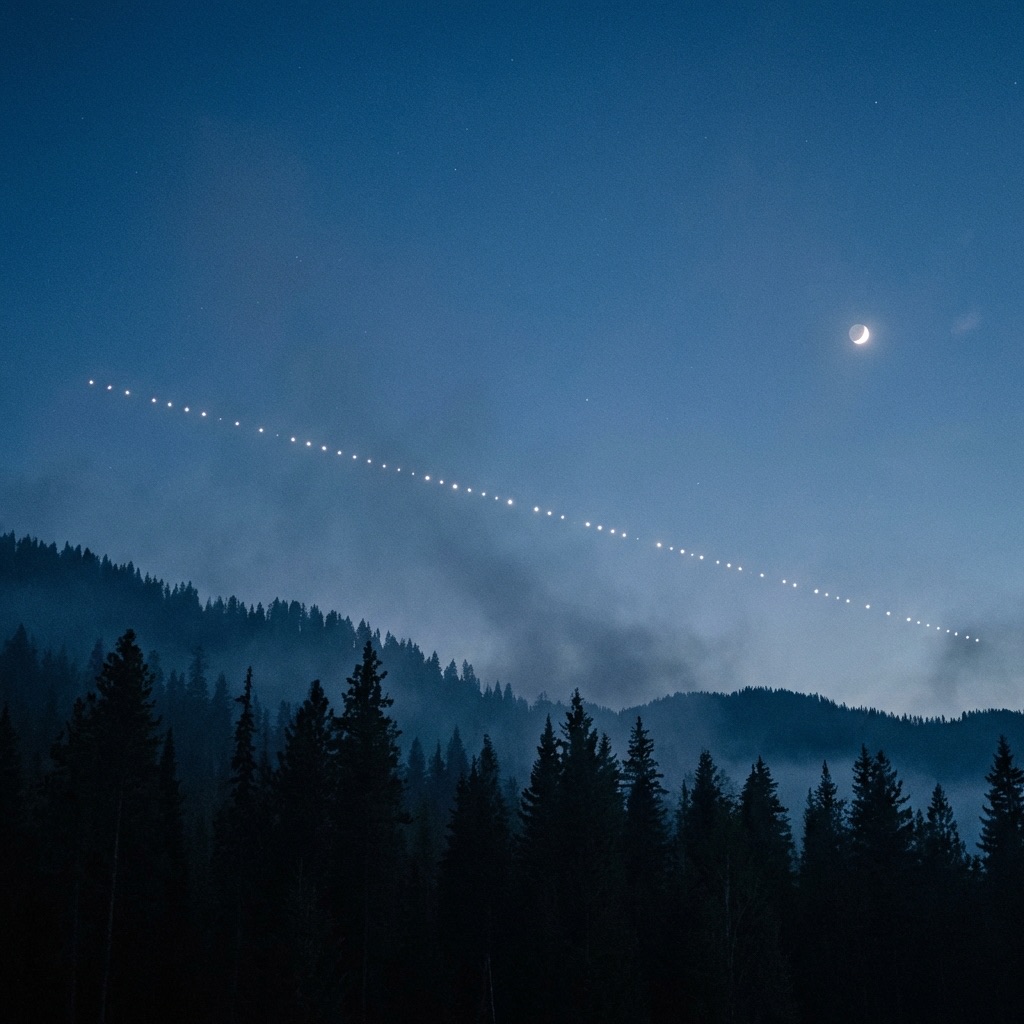
How to See Starlink Satellite Trains: A Beginner's Guide
Surreal and bright! Learn how to find, track, and photograph Starlink satellite trains glide across the night sky with our 2026 spotting guide.
Your First Night Stargazing: Complete 2026 Guide
Everything you need for your first night under the stars. Learn to find dark sky locations, navigate constellations, and master stargazing with zero gear.
Astrophotography on a Budget: Milky Way for Under $500
Learn to photograph the night sky with affordable equipment. Our complete gear guide shows you how to capture the Milky Way for under $500.
End of Dossier • Research Complete