ISS Spotting Guide: How to Track the Space Station Tonight
The International Space Station is the third-brightest object in the night sky after the Sun and Moon. It's also one of the easiest celestial objects to see—no telescope required, no dark skies needed. You can spot it from your backyard in the middle of a city. Here's everything you need to know to see astronauts fly overhead tonight.
DH Research Lab
Data & Editorial Board
Expert Tested Gear & Affiliate Disclosure
This guide contains affiliate links. As an Amazon Associate, we earn from qualifying purchases.
01What You'll See
The ISS appears as a brilliant, steady white light moving smoothly across the sky. Unlike airplanes, it has no blinking lights. Unlike satellites, it's bright enough to see even during dusk or from light-polluted cities.
Key visual characteristics:
- Bright as Venus (magnitude -3 to -5 during favorable passes)
- Moves from west to east
- Takes 3-6 minutes to cross the sky
- Appears to rise from one horizon and set on another
- Completely silent
At good angles, the ISS outshines every star in the sky. It's an unmistakable sight once you know what you're looking for.
Best Viewing Times
02When and Where to Look
The ISS orbits Earth every 92 minutes, but it's not visible on every pass. You need three conditions:
1. Timing The station must pass over your location during the 1-2 hours after sunset or before sunrise. During this window, you're in darkness but the ISS catches sunlight.
2. Altitude Higher passes (60°+ above the horizon) are brighter and longer. Low passes (under 20°) may be blocked by buildings or trees.
3. Clear skies Obviously! Check our Dashboard for real-time cloud cover.
Use our ISS tracker to see tonight's passes for your location.
Evening Passes
Look west as ISS rises, track east.
Morning Passes
Look east as ISS sets, track west.
Max Elevation
Higher = brighter and longer visible.
03How to Find the ISS
Step-by-step guide:
Get pass times for your location
- Use our Dashboard to see ISS passes
- NASA's "Spot the Station" sends email/text alerts
- Apps like ISS Detector provide notifications
Set up early
- Go outside 5 minutes before the predicted time
- Face the direction of appearance (usually west for evening passes)
- Let your eyes adjust to the dimness
Watch for movement
- The ISS will appear as a bright point rising from the horizon
- It moves noticeably faster than stars
- Track it across the sky until it fades (enters shadow) or sets
Pro tip: The ISS can appear to "fade out" mid-sky as it enters Earth's shadow. This is normal during late evening passes!
04Photographing the ISS
Capturing the ISS is surprisingly easy:
Basic Star Trail Method:
- Camera on tripod
- 10-30 second exposure
- ISO 400-800
- Wide aperture (f/4 or faster)
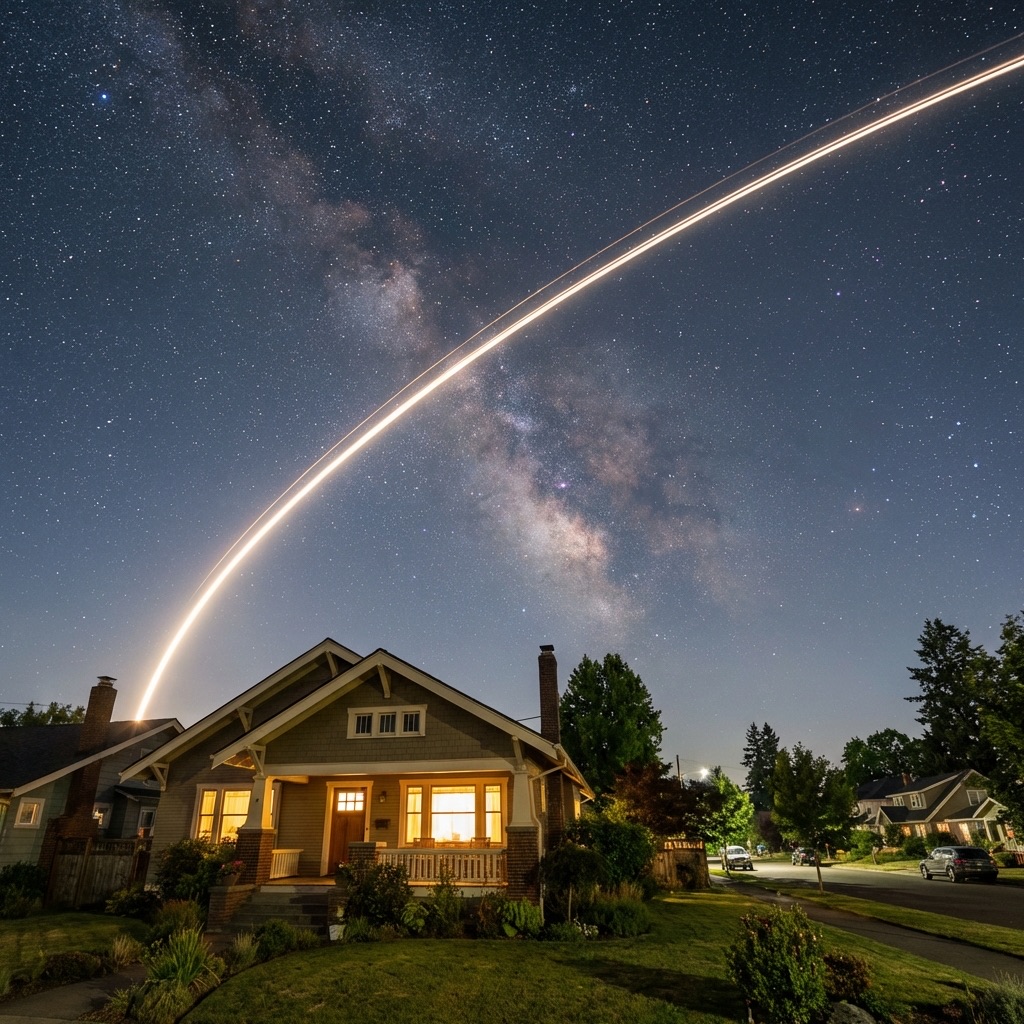
- Result: ISS appears as a bright streak among star trails
Multiple Exposure Composite:
- Take many 1-2 second exposures
- Stack in software to show ISS path
- Stars remain as points
Advanced: ISS Transit Photography With precise timing, you can photograph the ISS crossing the Sun or Moon. This requires:
- Telescope with solar filter (for Sun transits)
- Video mode at high frame rate
- Exact position based on transit calculator
ISS transits last only 0.5-1 second, so timing and location are critical.
Manfrotto Compact Action Tripod
“Stable, affordable tripod with smooth panning for tracking the ISS.”
RATIONALE
The fluid head lets you smoothly follow the ISS across the sky while filming.
05See the ISS with Binoculars or Telescope
Binoculars (7x-10x): At higher magnification, the ISS shows a distinct shape—you can see the solar panels extending from the central modules. It's small but clearly not a point of light.
Telescope: With a telescope, skilled observers can resolve the actual structure of the ISS: the solar arrays, modules, and even visiting spacecraft. This requires:
- GoTo mount with ISS tracking mode
- Practice tracking fast-moving objects
- Good seeing conditions
What you can see:
- Solar panels clearly extending from central body
- General "H" or cross shape
- Docked spacecraft (Crew Dragon, Soyuz)
- Color differences between modules
Tracking Challenge
06Beyond the ISS: Other Satellites
Once you've spotted the ISS, you'll start noticing other satellites:
Starlink Trains SpaceX's internet satellites are famous for appearing in "trains" after launch—dozens of bright points in a line. Use our Dashboard to check for recent Starlink launches.
Iridium Flares (Historical) The original Iridium satellites produced brilliant flares (up to magnitude -8!), but the new constellation doesn't flare. You may still catch occasional glints from other satellites.
Tiangong (Chinese Space Station) China's station is dimmer than the ISS but still visible. Track it the same way.
Random Satellites On any clear night, you'll see dozens of satellites if you're patient. Most are 3rd-5th magnitude, visible from dark sites.
Identifying What You See: Apps like Stellarium and SkySafari can identify satellites in real-time using your phone's camera. Point at a moving light and it'll tell you what it is.
Celestron 8x42 TrailSeeker ED Binoculars
“Sharp, lightweight binoculars perfect for satellite watching.”
RATIONALE
ED glass provides crisp views with minimal chromatic aberration. Great for resolving ISS shape.
07ISS Viewing Quick Reference
Checklist for tonight:
- Check pass times on our Dashboard
- Verify clear skies
- Note the direction of appearance
- Set a reminder 10 minutes before
- Go outside and watch the sky!
Best conditions:
- High passes (60°+ elevation)
- Clear skies
- Shortly after sunset
Quick facts:
- Orbits at 250 miles altitude
- Travels at 17,500 mph
- Circles Earth every 92 minutes
- Crew of typically 7 astronauts
- Size of a football field
The ISS is humanity's outpost in space, visible from almost anywhere on Earth. Every bright pass is a chance to wave at astronauts as they fly overhead.
Frequently Asked Questions
Q:How can I see the ISS tonight?
Check a pass prediction website or app for your location (like NASA's Spot the Station or our Dashboard). Go outside 5 minutes before the predicted time, face the direction of appearance (usually west for evening passes), and watch for a bright, steady light moving smoothly across the sky.
Q:What does the ISS look like from Earth?
The ISS appears as a bright, steady white light—similar brightness to Venus—moving smoothly across the sky. Unlike airplanes, it has no blinking lights. A pass takes 3-6 minutes from horizon to horizon.
Q:When is the best time to see the ISS?
The ISS is visible shortly after sunset or before sunrise, when you're in darkness but the station (250 miles up) is still sunlit. Mid-night passes are invisible because the ISS is in Earth's shadow.
Q:Can I see the ISS from the city?
Yes! The ISS is bright enough (magnitude -3 to -5) to see from light-polluted cities. You don't need dark skies—just clear skies and the right timing. It's often brighter than any star in the sky.
Q:How fast does the ISS travel across the sky?
The ISS travels at 17,500 mph, orbiting Earth every 92 minutes. From your perspective, it crosses the visible sky in 3-6 minutes, moving noticeably faster than stars or high-altitude aircraft.
Don't waste a clear-night chance
Get the field checklist, then use DarkestHour to decide if tonight's sky is actually worth your time, setup or travel.
Learn first. Decide with the map.
DarkestHour guides are free trust builders. Use them to understand conditions, then use Pro for saved spots, alerts and best-night decisions.
Find Your Darkest Sky
Use our real-time satellite maps to find locations with zero light pollution.
Launch Interactive MapYour Learning Roadmap
You've mastered the beginner basics. The next logical step in your technical progression is mastering intermediate acquisition.
MANDATORY FIELD EQUIPMENT
Celestron NexStar 8SE
The gold standard for deep-sky observation. 203mm aperture for maximum light gathering.
ZWO Seestar S50
Fully robotic imaging system. Perfect for urban environments and rapid deployment.
Peak Design Travel Tripod
Zero-latency stability for long exposure astrophotography. Carbon fiber construction.
Continue Your Research
Your First Night Stargazing: Complete 2026 Guide
Everything you need for your first night under the stars. Learn to find dark sky locations, navigate constellations, and master stargazing with zero gear.
Best Stargazing Gear for Beginners: Start Under $100
Everything you need for your first night under the stars—from comfort and clothing to celestial navigation apps and essential accessories.
Best Beginner Astronomy Gear: Your First Telescope Setup
A complete guide to your first telescope setup: expert recommendations for Dobsonians, essential eyepieces, and navigation aids for beginners.
End of Dossier • Research Complete