Best Beginner Astronomy Gear: Your First Telescope Setup
Setting up your first telescope follows a simple rule: getting the most light-gathering power for your budget while keeping things portable. This guide establishes the perfect baseline setup for new observers, focusing on the powerful and easy-to-use Dobsonian system.
DH Research Lab
Data & Editorial Board
Expert Tested Gear & Affiliate Disclosure
This guide contains affiliate links. As an Amazon Associate, we earn from qualifying purchases.
01The Best Beginner Telescope
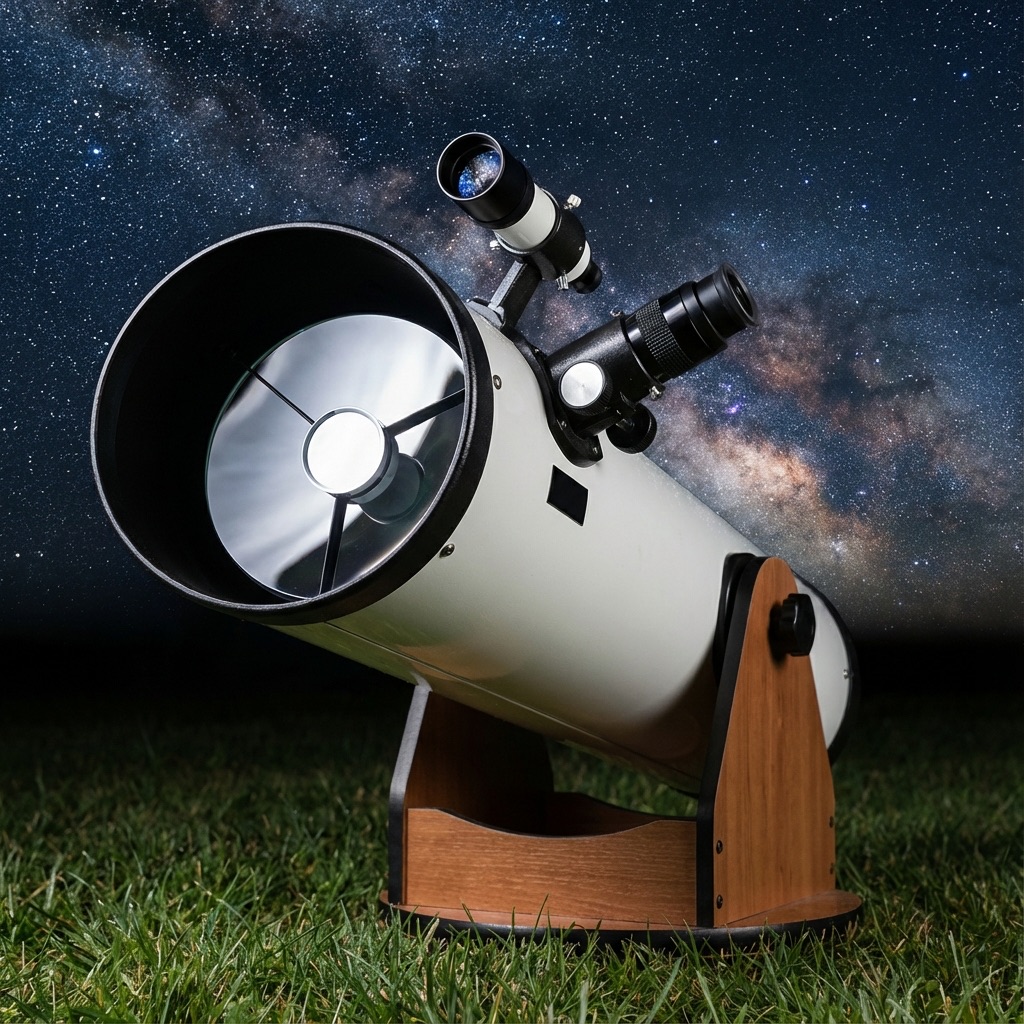
After helping dozens of beginners, my recommendation is simple: get a Dobsonian reflector.
Aperture is Everything. Reflecting telescopes use mirrors to gather light. A 200mm (8-inch) mirror collects 4 times more light than a 100mm mirror. This is the difference between seeing a 'gray smudge' and seeing the spiral arms of a galaxy.
Stability & Simplicity. While cheap tripods wobble in the wind, a Dobsonian sits on a solid base on the ground. You move it with your hands—no gears, no clutches, just point and observe.
Zero Tech Barriers. You don't need a laptop, a battery, or a PhD to use a Dobsonian. It's the most 'pure' way to experience the universe.
Apertura AD8 8-inch Dobsonian
“The gold standard for amateur astronomers.”
RATIONALE
It comes with a dual-speed focuser (essential for high magnification) and a high-quality 30mm wide-view eyepiece. It's the only scope you'll ever need for visual observing.
02The 'Holy Trinity' of Accessories
Your scope is only as good as what you put in the focuser. Here are the three upgrades every beginner needs:
1. A Quality Wide-Field Eyepiece — For finding objects and seeing large structures like the Andromeda Galaxy. 2. A High-Power Eyepiece — For seeing the cloud bands of Jupiter and the rings of Saturn. 3. A Red-Dot Finder — A small laser-sighted tool that helps you point the big telescope exactly where you're looking.
The Book: I also highly recommend 'Turn Left at Orion.' It's the amateur astronomy bible. It shows you what objects actually look like through a telescope, not Hubble photos.
Dark Adaptation is Gear, Too
03Comfort & Maintenance
The best telescope is the one you use most. If you're cold or your back hurts, you won't observe for long.
Observing Chair: An adjustable-height 'Vestil' or 'Astro' chair lets you sit comfortably regardless of where the telescope is pointing.
Collimation: Because reflecting telescopes use mirrors, they occasionally need to be aligned. Don't be intimidated—it's like tuning a guitar. A laser collimator makes this a 2-minute process before you start your session.
Planetary Filters
A simple moon filter or blue filter can reveal subtle details in the gas giants.
Dew Shields
Stops condensation from forming on your secondary mirror during humid nights.
Storage
Keep your scope in a garage or shed so it's already near outdoor temperatures when you start.
Frequently Asked Questions
Q:Why should I buy a Dobsonian instead of a tripod telescope?
For the same price, a Dobsonian gives you a much larger mirror (aperture), which means you can see fainter objects. High-quality tripods are also very expensive; cheap ones are frustratingly wobbly.
Q:Is it hard to find planets and galaxies?
It takes practice, but using a 'red-dot finder' or a 'Telrad' makes it as easy as pointing a laser pointer. Free smartphone apps can also show you exactly where to point.
Q:Can I see color through a telescope?
Most deep sky objects (galaxies, nebulae) appear as gray or greenish-gray smudges because our eyes aren't sensitive enough to see color in low light. Planets like Jupiter and Mars, however, show beautiful colors.
Q:How do I take care of the mirrors?
Keep the caps on when not in use. Mirrors rarely need cleaning—once every few years is typical. Dust doesn't affect the image nearly as much as scratches from improper cleaning.
Q:Can I use my telescope from a city balcony?
Yes! While light pollution makes galaxies hard to see, the Moon and planets (Jupiter, Saturn, Venus) look incredible even from a bright city center.
Don't waste a clear-night chance
Get the field checklist, then use DarkestHour to decide if tonight's sky is actually worth your time, setup or travel.
Learn first. Decide with the map.
DarkestHour guides are free trust builders. Use them to understand conditions, then use Pro for saved spots, alerts and best-night decisions.
Find Your Darkest Sky
Use our real-time satellite maps to find locations with zero light pollution.
Launch Interactive MapYour Learning Roadmap
You've mastered the beginner basics. The next logical step in your technical progression is mastering intermediate acquisition.
MANDATORY FIELD EQUIPMENT
Celestron NexStar 8SE
The gold standard for deep-sky observation. 203mm aperture for maximum light gathering.
ZWO Seestar S50
Fully robotic imaging system. Perfect for urban environments and rapid deployment.
Peak Design Travel Tripod
Zero-latency stability for long exposure astrophotography. Carbon fiber construction.
Continue Your Research
The Best Telescopes for Beginners 2026: Buyer's Guide
Don't waste money on a shaky scope. Find the best first telescope with our 2026 expert reviews, budget picks, and essential gear advice.
Best Binoculars for Astronomy 2026: Top Expert Picks
Experience the universe in 3D. Discover why 10x50 binoculars are the ultimate first step in astronomy. We review the top budget and premium picks for 2026.
Meteor Shower Calendar 2026: Don't Miss These Events
Your complete guide to every major meteor shower in 2026. Find peak dates, hourly rates (ZHR), and expert photography tips for each event.
End of Dossier • Research Complete