Dark Sky Reserves: Top 15 Global Destinations for Stargazing
There's a reason astronomers and astrophotographers travel thousands of miles to stand in specific spots on Earth. These aren't just dark places—they're sanctuaries where light pollution is actively fought, where the Milky Way doesn't just appear but *blazes* overhead. I've visited seven of these reserves over the past decade, and each one changed how I see the night sky. Here are the world's finest dark sky destinations, what makes each unique, and how to plan your own pilgrimage to the stars.
DH Research Lab
Data & Editorial Board
Expert Tested Gear & Affiliate Disclosure
This guide contains affiliate links. As an Amazon Associate, we earn from qualifying purchases.
01What is a Dark Sky Reserve?
The International Dark-Sky Association (IDA) certifies locations that demonstrate exceptional commitment to preserving the night sky. There are several designations:
- Dark Sky Parks — Public lands with exceptional starry skies and programs for night sky education
- Dark Sky Reserves — Large areas with a dark core surrounded by a protected buffer zone
- Dark Sky Sanctuaries — The most remote and darkest places on Earth
These aren't just marketing labels. Certified locations must prove Bortle Class 3 or darker skies, implement lighting ordinances, and provide public stargazing access.
Use our Dark Sky Map to check current conditions before you travel.
Pro Tip: Timing Matters
021. NamibRand Nature Reserve, Namibia
Bortle Class: 1 — The gold standard.
NamibRand isn't just dark—it's one of the darkest places on the planet. Located in the Namib Desert, this 215,000-hectare private reserve earned Africa's first International Dark Sky Reserve designation.
What makes it special:
- Zero artificial light visible to the horizon in any direction
- Year-round clear skies due to desert climate
- Southern Hemisphere access: Magellanic Clouds, Southern Cross, Centaurus A
- Luxury lodges with dedicated astronomy guides
Best time to visit: April-October (dry season) Nearest airport: Windhoek (5-hour drive)
Celestron SkyMaster Pro 15x70 Binoculars
“Large aperture binoculars perfect for sweeping the Milky Way's southern reaches.”
RATIONALE
The wide field of view captures the full majesty of the Magellanic Clouds—something you can't see from the Northern Hemisphere.
032. Aoraki Mackenzie, New Zealand
Bortle Class: 1-2
The world's largest dark sky reserve covers 4,367 square kilometers surrounding New Zealand's highest peak, Aoraki/Mount Cook. The reserve includes the University of Canterbury's Mt. John Observatory.
What makes it special:
- Southern Hemisphere deep sky objects
- Reflection of stars in glacier-fed Lake Tekapo
- Active research observatory with public tours
- Incredible aurora australis during geomagnetic storms
Best time to visit: March-September (winter = longer nights) Nearest airport: Christchurch (3-hour drive)
The Astro Café at Mt. John Observatory is the only place I've had a flat white while watching the sun set behind the Southern Alps, then stepped outside to see the Milky Way rise.
Planning a trip? Check out our dedicated deep dive: New Zealand Dark Sky Sanctuaries: The Ultimate Stargazing Road Trip.
Aurora Bonus
043. Brecon Beacons, Wales
Bortle Class: 3-4
For those in Europe, Brecon Beacons offers accessible darkness just a few hours from London. It became Wales's first International Dark Sky Reserve in 2013.
What makes it special:
- Year-round accessibility from major UK cities
- Dark sky discovery sites with parking and viewing platforms
- Local star parties and astronomy events
- Rolling hills provide natural light barriers
Best time to visit: September-March (clearer, longer nights) Nearest airport: Cardiff or Bristol (1-hour drive)
Orion StarBlast 4.5 Astro Reflector Telescope
“Compact tabletop Dobsonian perfect for travel.”
RATIONALE
Light enough to carry on UK train travel, powerful enough to resolve globular clusters and planetary detail.
054. Big Bend National Park, Texas, USA
Bortle Class: 2
Deep in southwest Texas where the Rio Grande carves through desert canyons, Big Bend offers some of the darkest skies in North America. The nearest city of 50,000+ people is over 200 miles away.
What makes it special:
- 99% of the park has "excellent" dark sky quality
- Year-round star parties hosted by the park
- Dramatic desert landscapes for astrophotography foregrounds
- Hot springs viewing at night
Best time to visit: October-April (avoid extreme summer heat) Nearest airport: Midland-Odessa (4-hour drive) or El Paso (5 hours)
Star Parties
Free ranger-led programs every month.
New Moon Events
Special viewing nights during new moon phases.
Photo Ops
Balanced Rock and Window Trail offer iconic foregrounds.
065. Pic du Midi, France
Bortle Class: 2
Perched at 2,877 meters in the French Pyrenees, Pic du Midi is both an active astronomical observatory and the world's highest designated Dark Sky Reserve.
What makes it special:
- Above the haze layer for crystal clarity
- Observatory access for public (night stays available)
- 360° mountain panorama horizon
- Adjacent ski resort infrastructure
Best time to visit: June-September (accessible cable car) or winter for skiing + stargazing combo Nearest airport: Toulouse (2-hour drive + cable car)
Spending a night inside a professional observatory, using their telescopes, is a once-in-a-lifetime experience.
076. Cherry Springs State Park, Pennsylvania, USA
Bortle Class: 2
On the East Coast of the United States, genuine dark skies are rare. Cherry Springs is the exception—an 82-acre hilltop park that's become a pilgrimage site for East Coast astronomers.
What makes it special:
- Darkest skies east of the Mississippi
- Dedicated astronomy field with red-light-only rules
- Regular star parties and astronomy events
- Surrounded by state forest buffer
Best time to visit: March-October (avoiding mud season) Nearest airport: Elmira, NY (1.5 hours) or Pittsburgh (4 hours)
Explore Scientific AR102 Air-Spaced Doublet Refractor
“Sharp, portable refractor ideal for double stars and lunar observation.”
RATIONALE
Cherry Springs regulars love refractors for their sharp, high-contrast views. This one packs down for the drive.
087. Warrumbungle National Park, Australia
Bortle Class: 2
Australia's first Dark Sky Park sits in the volcanic landscapes of New South Wales. The iconic Siding Spring Observatory—home to some of Australia's most important telescopes—anchors the region.
What makes it special:
- Southern Hemisphere celestial treasures
- Volcanic rock formations for astrophotography
- Observatory public nights
- Kangaroos as stargazing companions (seriously)
Best time to visit: March-October (dry season) Nearest airport: Sydney (6-hour drive)
Bushfire Season
098. Galloway Forest Park, Scotland
Bortle Class: 3
Britain's largest forest park was the UK's first Dark Sky Park. Nestled in southern Scotland, it offers genuine darkness without extreme remoteness.
What makes it special:
- Accessible from Edinburgh and Glasgow
- 3 designated dark sky sites within the park
- Scottish Crannog Centre star parties
- Northern lights visible during strong storms
Best time to visit: September-March (longer nights) Nearest airport: Glasgow or Edinburgh (2-hour drive)
109. Atacama Desert, Chile
Bortle Class: 1
The driest desert on Earth is also home to the world's greatest concentration of major observatories: ALMA, VLT, E-ELT, Gemini South. If it's good enough for billion-dollar telescopes, it's good enough for you.
What makes it special:
- 300+ clear nights per year
- High altitude (2,400m+) reduces atmospheric distortion
- Southern Hemisphere + equatorial visibility
- Professional tours of working observatories
Best time to visit: March-November (avoid summer rains) Nearest airport: Calama (2-hour drive to San Pedro de Atacama)
Sky-Watcher Star Adventurer 2i Pro Pack
“Portable star tracker for deep sky astrophotography.”
RATIONALE
The Atacama's steady skies are wasted without long exposures. This tracker lets you capture nebulae with a DSLR.
1110. Mauna Kea, Hawaii, USA
Bortle Class: 1-2
At 4,205 meters, Mauna Kea hosts the world's largest collection of optical, infrared, and submillimeter telescopes. The visitor station at 2,800m offers public stargazing without full summit altitude.
What makes it special:
- Above 40% of Earth's atmosphere
- Minimal light pollution from Hilo and Kona lighting ordinances
- Free nightly stargazing programs at Visitor Center
- Summit access to see professional observatory domes
Best time to visit: Year-round (check road conditions) Nearest airport: Kona or Hilo (2-hour drive to summit)
Altitude Caution
1211-15: More Dark Sky Gems
Rounding out the list:
| Rank | Destination | Country | Bortle | Highlight |
|---|---|---|---|---|
| 11 | Jasper National Park | Canada | 2 | Largest dark sky preserve |
| 12 | Exmoor National Park | UK | 3 | Coastal dark skies |
| 13 | GOBE Tower, Estonia | Estonia | 2 | Purpose-built observation tower |
| 14 | Teide National Park | Spain (Canary Islands) | 2 | Professional-grade transparency |
| 15 | Westhavelland | Germany | 3 | First German Dark Sky Reserve |
Each of these offers world-class stargazing with its own unique character. Use our Dark Sky Map to compare conditions before booking.
13Planning Your Dark Sky Trip
After visiting seven reserves, here's my essential planning checklist:
Before Booking:
- Check our Dark Sky Map for Bortle ratings
- Research moon phases—book around new moon
- Verify seasonal access (some close in winter/summer)
- Check local weather patterns
What to Pack:
- Red headlamp (preserves night vision)
- Binoculars at minimum
- Warm layers (even desert nights are cold)
- Reclining chair or camping mat
- Star chart or planisphere
- Camera + tripod for astrophotography
On Location:
- Arrive before sunset for setup
- Allow 30+ minutes for dark adaptation
- Avoid phone screens (use red filter if necessary)
- Join local star parties for insider knowledge
PETZL TACTIKKA +RGB Headlamp
“Red, green, and blue LED modes for complete night vision preservation.”
RATIONALE
The dedicated red mode is dimmer than most—crucial for not ruining your or others' dark adaptation.
Don't waste a clear-night chance
Get the field checklist, then use DarkestHour to decide if tonight's sky is actually worth your time, setup or travel.
Learn first. Decide with the map.
DarkestHour guides are free trust builders. Use them to understand conditions, then use Pro for saved spots, alerts and best-night decisions.
Find Your Darkest Sky
Use our real-time satellite maps to find locations with zero light pollution.
Launch Interactive MapPlan Your Deployment
Ready to experience these dark skies yourself? Use our interactive map to find the best dark-sky certified hotels, desert cabins, and observatories near this location.
Booking through this map supports Darkest Hour's light pollution research.
Your Learning Roadmap
You've mastered the beginner basics. The next logical step in your technical progression is mastering intermediate acquisition.
MANDATORY FIELD EQUIPMENT
Celestron NexStar 8SE
The gold standard for deep-sky observation. 203mm aperture for maximum light gathering.
ZWO Seestar S50
Fully robotic imaging system. Perfect for urban environments and rapid deployment.
Peak Design Travel Tripod
Zero-latency stability for long exposure astrophotography. Carbon fiber construction.
Continue Your Research
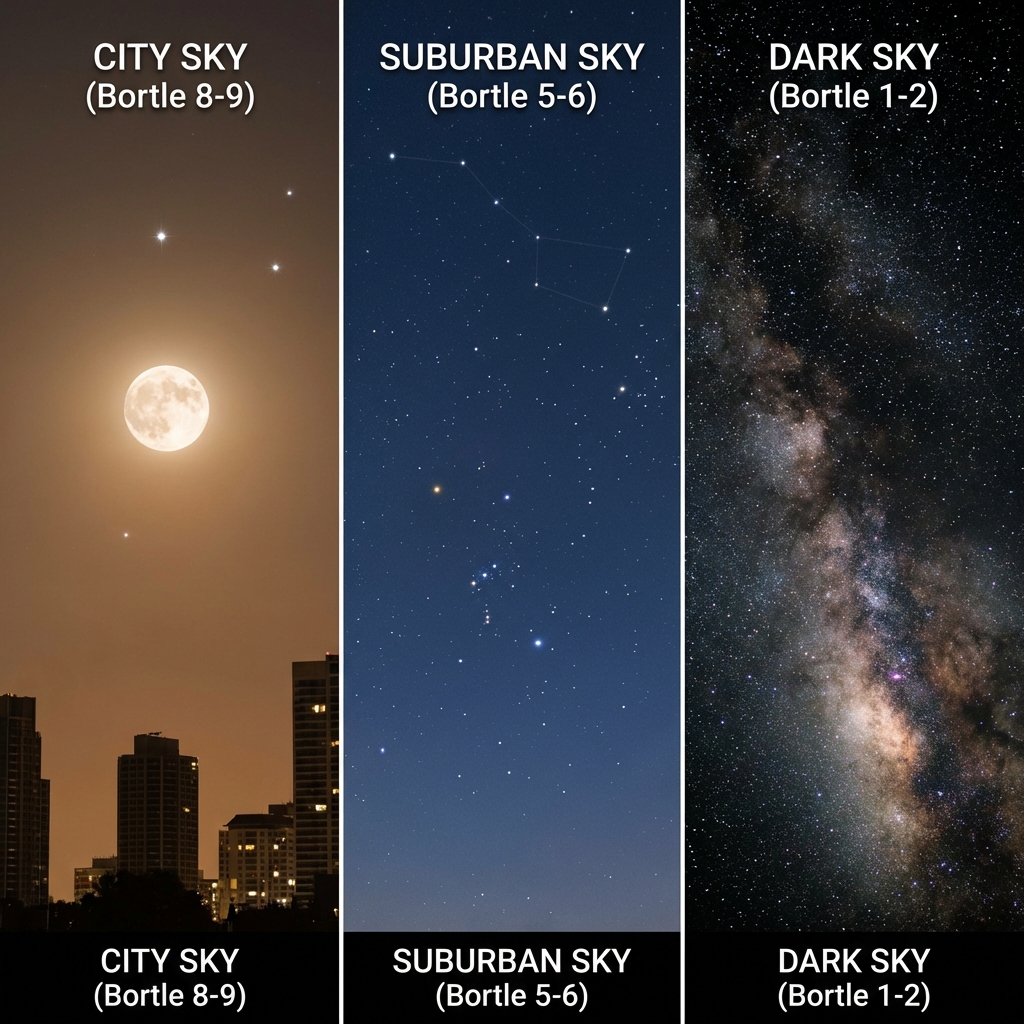
How to Read a Bortle Scale Map: The Dark Sky Cheat Code
Decode light pollution maps and understand Bortle classes 1 to 9. Use our advanced dark sky tools to find your perfect stargazing location tonight.
Your First Night Stargazing: Complete 2026 Guide
Everything you need for your first night under the stars. Learn to find dark sky locations, navigate constellations, and master stargazing with zero gear.
Astrophotography for Beginners: Start with Your Phone
You don't need a DSLR. Learn how to capture the Moon, star trails, and even the Milky Way using just your smartphone and under $100 in accessories.
End of Dossier • Research Complete