
Finding Stars Near Seattle: Top Observing Spots
Stargazing around Seattle requires a bit of planning. To see the Milky Way or faint meteor showers, you have to escape the city's luminous footprint. We've compiled the ultimate list of dark sky escapes in the area.

DH Research Lab
Data & Editorial Board
Expert Tested Gear & Affiliate Disclosure
This guide contains affiliate links. As an Amazon Associate, we earn from qualifying purchases.
01When to Leave the City
The key to stargazing near Seattle is timing the weather. Allow at least an hour of driving time past the suburban perimeter to let your eyes adjust to the dropping light pollution.
02Navigating Northwest Weather
The Pacific Northwest requires a different strategy than desert regions:
The Rain Shadow: Eastern Washington sees 300+ days of sunshine, compared to Seattle's 150. Cross the Cascades for dramatically better odds.
Summer Advantage: June-September offers the best combination of clear skies and warm temperatures. Winter is cloudier but has longer nights.
Check Forecasts: NWS weather, ClearDarkSky, and satellite imagery should all be consulted before driving.
Be Flexible: Sometimes the best strategy is deciding to go the day before, when forecasts are more reliable.
The Cascade Curtain
031. Goldendale Observatory (Eastern Washington)
Distance from Seattle: 4 hours | Bortle Class: 3 | Best For: Public observatory, eastern WA clear skies
Goldendale Observatory sits in the rain shadow on the Columbia Plateau. It houses one of the largest public telescopes in the nation—a 24.5-inch Cassegrain.
What to Expect:
- Public programs Wednesday-Sunday evenings
- 24.5-inch telescope shows incredible detail
- Eastern WA means clearer skies than the coast
Town Tip: The town of Goldendale has adopted dark-sky-friendly lighting policies.
Sky-Watcher Heritage 130P FlexTube Dobsonian
“Collapsible Dob that fits easily in your car.”
RATIONALE
Road trips through the Cascades mean limited space. This 130mm scope collapses for transport and shows impressive detail.
042. Mount Rainier National Park
Distance from Seattle: 2 hours | Bortle Class: 3-4 | Best For: Iconic mountain backdrop, summer Milky Way
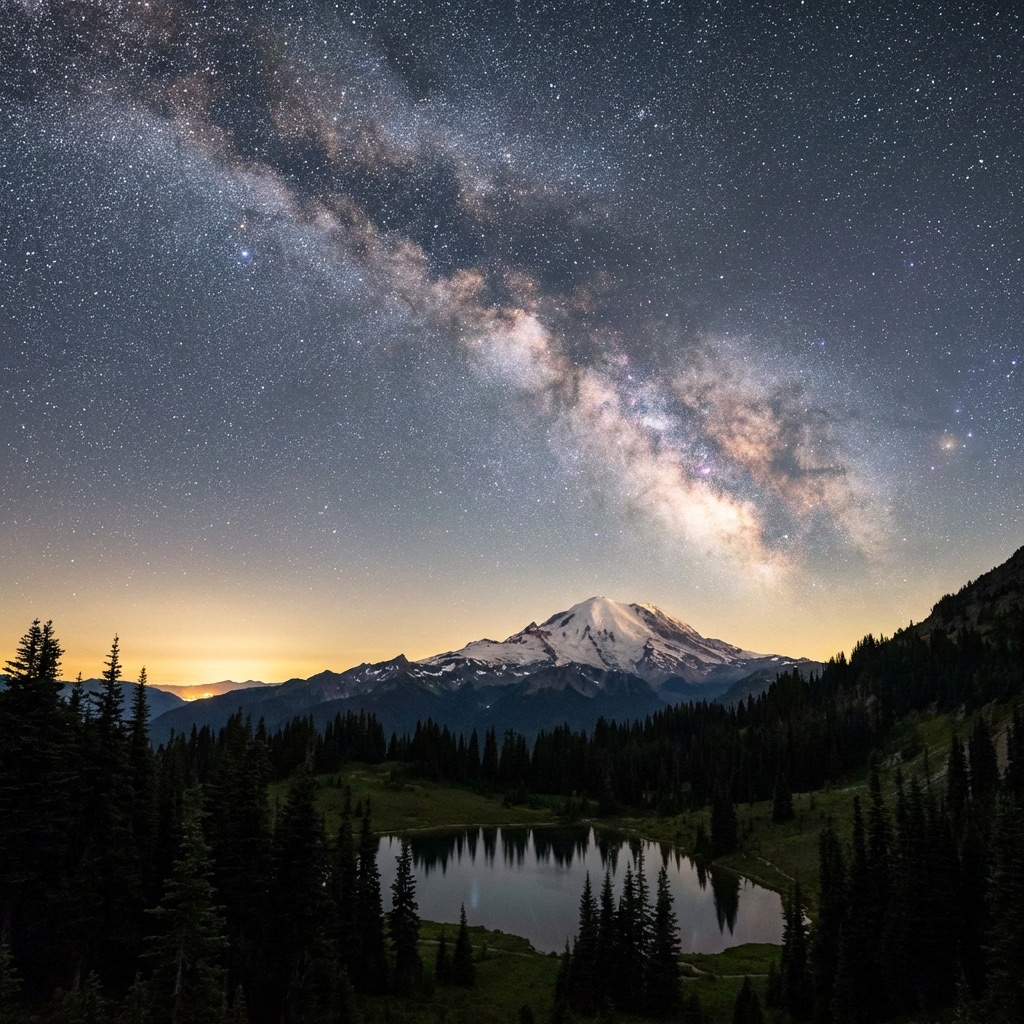
Rainier's 14,411-foot summit creates one of the most dramatic astrophotography foregrounds on Earth. On clear summer nights, the Milky Way arcs directly over the glaciated peak.
Viewing Spots:
- Reflection Lakes — Classic Rainier reflection shots at night
- Sunrise Area — East side, often clearer
- Paradise — Alpine meadows, but often cloudy
Summer Only: Many roads close October-May. Check conditions.
Iconic
One of the most photographed night sky landscapes in America.
Reflections
Alpine lakes mirror the stars beautifully.
Weather Gamble
Clear nights are spectacular but not guaranteed.
053. Olympic National Park
Distance from Seattle: 3-4 hours | Bortle Class: 2-3 | Best For: Remote wilderness, varied landscapes
Olympic's size and remoteness create excellent dark sky conditions—if the weather cooperates. The park ranges from rainforest to alpine to coastal, each offering unique night sky experiences.
Locations:
- Hurricane Ridge — Alpine meadows, night sky programs
- Rialto Beach — Sea stacks and stars, dramatic
- Hoh Rain Forest — Dark but often cloudy
Best Bet: Hurricane Ridge has the best combination of access and dark skies. Check for clear nights.
Outdoor Research Helium Rain Jacket
“Ultralight waterproof layer for unpredictable PNW weather.”
RATIONALE
Weather changes fast in the Olympics. A packable rain layer prevents a ruined session when fog rolls in.
064. Spokane Area (Eastern Washington)
Distance from Seattle: 4.5 hours | Bortle Class: 4-5 | Best For: High probability of clear skies
Spokane isn't dark by itself, but a short drive into the surrounding areas offers Bortle 4-5 skies with much more reliable weather than the coast.
Where to Go:
- Turnbull National Wildlife Refuge — 30 minutes south
- Mount Spokane State Park — Higher elevation, darker
- Palouse Hills — Rolling farmland with wide horizons
Strategy: Base in Spokane for amenities, drive 30-45 minutes for darker skies.
Palouse Country
075. San Juan Islands
Distance from Seattle: 3 hours (with ferry) | Bortle Class: 4 | Best For: Unique island stargazing, orcas by day
The San Juan Islands offer a unique Pacific Northwest experience—stargazing over Puget Sound with the chance of bioluminescence in the water below.
Islands to Consider:
- San Juan Island — Most services, decent dark skies away from Friday Harbor
- Orcas Island — Mount Constitution offers 360° views
- Lopez Island — Quieter, darker
Ferry Note: Late return ferries are limited. Plan to stay overnight.
Unique Setting
Stars above, phosphorescent water below.
Weekend Trip
Combine astronomy with whale watching and island exploration.
Light Protection
Islands have limited development and dark-sky awareness.
086. North Cascades National Park
Distance from Seattle: 2.5 hours | Bortle Class: 2-3 | Best For: Alpine wilderness, extreme darkness
The North Cascades are among the least-visited national parks—which means genuinely dark skies in rugged mountain wilderness. The challenge is access; many areas require hiking.
Accessible Options:
- Diablo Lake Overlook — Stunning turquoise lake views, road accessible
- Washington Pass Overlook — High elevation, dramatic peaks
- Ross Lake — Requires boat or hike, but extremely dark
Season: Highway 20 closes November-May (weather dependent). Check conditions.
Nitecore NU25 Headlamp
“Ultralight USB rechargeable with red light mode.”
RATIONALE
Weighing just 1 oz, this headlamp is perfect for hiking to remote stargazing spots while keeping your pack light.
09PNW Stargazing Essentials
Weather Preparation:
- Always pack rain gear, even if forecast is clear
- Layering system: base, insulation, waterproof shell
- Set realistic expectations—cloudy nights happen
Gear:
- Red LED headlamp
- Rain jacket (always)
- Warm layers (nights are cool even in summer)
- Hand warmers
- Thermos with hot drinks
- Wide-angle fast lens for Milky Way
Best Months:
- July-August: Best weather, but shortest true darkness (far north = late twilight)
- September: Excellent conditions, Milky Way still visible, fewer crowds
- March-April: Clear streaks possible, variable
Cloud Resources:
- ClearDarkSky.com for specific sites
- NWS satellite loops
- Local astronomy club reports
Chase the Clear
Don't waste a clear-night chance
Get the field checklist, then use DarkestHour to decide if tonight's sky is actually worth your time, setup or travel.
Learn first. Decide with the map.
DarkestHour guides are free trust builders. Use them to understand conditions, then use Pro for saved spots, alerts and best-night decisions.
Find Your Darkest Sky
Use our real-time satellite maps to find locations with zero light pollution.
Launch Interactive MapPlan Your Deployment
Ready to experience these dark skies yourself? Use our interactive map to find the best dark-sky certified hotels, desert cabins, and observatories near this location.
Booking through this map supports Darkest Hour's light pollution research.
Your Learning Roadmap
You've mastered the destinations basics. The next logical step in your technical progression is mastering astrophotography workflows.
MANDATORY FIELD EQUIPMENT
Celestron NexStar 8SE
The gold standard for deep-sky observation. 203mm aperture for maximum light gathering.
ZWO Seestar S50
Fully robotic imaging system. Perfect for urban environments and rapid deployment.
Peak Design Travel Tripod
Zero-latency stability for long exposure astrophotography. Carbon fiber construction.
Continue Your Research
Your First Night Stargazing: Complete 2026 Guide
Everything you need for your first night under the stars. Learn to find dark sky locations, navigate constellations, and master stargazing with zero gear.
Astrophotography on a Budget: Milky Way for Under $500
Learn to photograph the night sky with affordable equipment. Our complete gear guide shows you how to capture the Milky Way for under $500.
Stargazing in Banff: 6 Canadian Rockies Escapes
Glacial stars await! 6 spots in Banff National Park—Lake Louise, Icefields Parkway, and Peyto Lake. Your guide to Rockies' stargazing.
End of Dossier • Research Complete