Where to Go Stargazing in Los Angeles: Top Dark Sky Spots
Stargazing around Los Angeles requires a bit of planning. To see the Milky Way or faint meteor showers, you have to escape the city's luminous footprint. We've compiled the ultimate list of dark sky escapes in the area.
DH Research Lab
Data & Editorial Board
Expert Tested Gear & Affiliate Disclosure
This guide contains affiliate links. As an Amazon Associate, we earn from qualifying purchases.
01When to Leave the City
The key to stargazing near Los Angeles is timing the weather. Allow at least an hour of driving time past the suburban perimeter to let your eyes adjust to the dropping light pollution.
02Understanding Dark Skies Near LA
Before we dive into locations, let's talk about what makes a great stargazing spot:
The Bortle Scale: Astronomers rate sky darkness on a 1-9 scale. Los Angeles city center is Bortle 8-9 (worst). We only included spots that score Bortle 4 or better—meaning you'll see the Milky Way clearly.
Driving Distance: All locations are within 3 hours of downtown LA. Most are 2-2.5 hours.
Best Times to Go:
- New Moon weekends — No moonlight washing out stars
- Weeknights — Fewer crowds at popular spots
- Winter months — Clearer air, earlier darkness, Orion overhead
Use Our Dark Sky Map
031. Joshua Tree National Park
Distance from LA: 2.5 hours | Bortle Class: 3-4 | Best For: Beginners & photographers
Joshua Tree is the most accessible world-class dark sky near LA. The park earned International Dark Sky Park status in 2017, and for good reason—on moonless nights, the Milky Way stretches from horizon to horizon.
Top Viewing Spots:
- Keys View — Paved pullout with stunning desert vistas
- Cap Rock — Easy access, iconic boulder formations
- Cottonwood Spring — Southern entrance, less crowded
Pro Tips:
- Arrive before sunset to secure parking at popular spots
- Summer temps can exceed 100°F—bring water and go in spring/fall
- The unique Joshua Trees make incredible foregrounds for astrophotography
Celestron 15x70 SkyMaster Binoculars
“See craters on the Moon and Jupiter's moons without a telescope.”
RATIONALE
For a first trip to dark skies, binoculars reveal more than you'd expect. These 70mm objectives gather serious light and stay under $100.
042. Death Valley National Park
Distance from LA: 4-5 hours | Bortle Class: 1-2 | Best For: Serious astronomers & Milky Way photography
Death Valley offers some of the darkest skies in North America. The combination of extreme remoteness, low humidity, and below-sea-level terrain creates conditions that rival professional observatories.
Top Viewing Spots:
- Mesquite Flat Sand Dunes — Iconic dune foregrounds
- Badwater Basin — The lowest point in North America (-282 ft)
- Ubehebe Crater — Dramatic volcanic rim views
Warning: Summer temperatures regularly exceed 120°F. Visit October-April only. Always carry extra water and check road conditions.
Bortle 1-2
Among the darkest accessible skies in the continental US.
Zodiacal Light
Visible here—the faint glow of sunlight reflecting off interplanetary dust.
Photography
Salt flats and dunes create otherworldly astrophotography foregrounds.
053. Anza-Borrego Desert State Park
Distance from LA: 2.5 hours | Bortle Class: 3-4 | Best For: Beginners, wildflower season combo trips
California's largest state park is also an International Dark Sky Park. Less crowded than Joshua Tree, Anza-Borrego offers excellent skies with unique desert sculptures and spring wildflower displays.
Top Viewing Spots:
- Font's Point — "The Badlands" overlook, accessible by 4WD
- Blair Valley — Easy access, pictographs nearby
- Borrego Springs (town) — One of only two Dark Sky Communities in California
Special Feature: The town of Borrego Springs itself has dark sky lighting ordinances. You can literally stargaze from your hotel parking lot.
Red LED Headlamp
“Preserve your night vision while setting up gear.”
RATIONALE
Essential for any dark sky trip. White light destroys your night vision for 20+ minutes. Red light lets you see without affecting your eyes.
064. Mount Pinos
Distance from LA: 2 hours | Bortle Class: 4 | Best For: Telescope users, astronomy clubs
The closest truly dark sky to LA, Mount Pinos is a favorite of local astronomy clubs. At 8,847 feet elevation, you're above much of the atmospheric haze that plagues lower sites.
What to Expect:
- Large paved parking area designed for stargazers
- Often busy on weekend new moon nights
- Active astronomy club presence—great for beginners to learn
Access Notes: Snow closes the road in winter. Check conditions before driving up. Summer nights can be surprisingly cold at elevation—bring layers.
Club Star Parties
075. Trona Pinnacles
Distance from LA: 3 hours | Bortle Class: 3 | Best For: Unique landscape photography
The Trona Pinnacles are 500+ tufa spires rising from a dry lakebed—an alien landscape that's been used in countless sci-fi films. At night, it becomes one of the most photogenic dark sky locations in California.
Why It's Special:
- Surreal rock formations create one-of-a-kind foregrounds
- Very few visitors—you'll likely be alone
- BLM land, so camping is permitted
Downsides:
- Rough dirt road access (high-clearance recommended)
- No facilities, no water, no cell service
- Genuinely remote—be prepared
Anker PowerCore 26800mAh Power Bank
“Keep your phone, camera, and star tracker running all night.”
RATIONALE
Remote stargazing means no outlets. This bank can charge your phone 6+ times and run camera accessories for hours.
086. Big Bear Lake (San Bernardino Mountains)
Distance from LA: 2 hours | Bortle Class: 4-5 | Best For: Combining with weekend cabin trip
Big Bear isn't the darkest option, but it's one of the most accessible mountain escapes from LA. The skies are significantly better than anything in the basin, and you can combine stargazing with other mountain activities.
Best Spots:
- Holcomb Valley Road — North of Big Bear, darker skies
- Butler Peak Lookout — Higher elevation viewpoint
- Big Bear Solar Observatory area — Good southern views
Bonus: The Big Bear Solar Observatory occasionally offers public programs. The lake itself makes a beautiful moonrise/moonset viewing spot.
Weekend Trip
Rent a cabin, hike during the day, stargaze at night.
Seasonal
Winter means snow sports + stargazing. Summer nights are warm and pleasant.
Accessible
Paved roads, restaurants, gas stations—easy for beginners.
097. Mojave National Preserve
Distance from LA: 3-3.5 hours | Bortle Class: 2-3 | Best For: Serious darkness, solitude
Sandwiched between Death Valley and Joshua Tree, the Mojave Preserve is often overlooked—which is exactly why it's special. The skies here approach Death Valley quality with easier access.
Top Viewing Spots:
- Kelso Dunes — 600-foot dunes, virtually no light pollution
- Hole-in-the-Wall — Established campground, dark skies
- Cima Dome — World's largest Joshua tree forest
Practical Notes: Free camping at designated areas. Limited cell service. Carry extra fuel—gas stations are sparse.
OLIGHT Marauder 2 Flashlight
“14,000 lumens for emergencies, but also has red mode for astronomy.”
RATIONALE
When you're in the true backcountry, a serious flashlight is a safety tool. This one has an astronomy-friendly red mode for star sessions.
10Essential Gear Checklist
Every Dark Sky Trip:
- Red LED headlamp (non-negotiable)
- Layers (desert nights get cold!)
- Camping chair or blanket
- Star chart app (Stellarium, SkySafari)
- Snacks and water
If You're Photographing:
- Sturdy tripod
- Wide-angle fast lens (f/2.8 or faster)
- Extra batteries (cold kills them)
- Intervalometer for long exposures
Optional But Game-Changing:
- Binoculars (10x50 ideal)
- Portable star tracker for astrophotography
- Thermos with hot drinks
Check Moon Phase Before You Go
Observing Strategy
Curated Field Guide
Difficulty
Beginner
Best Window
April to October (New Moon)
Sky Quality
Recommended Targets:
Frequently Asked Questions
Q:Is Joshua Tree good for stargazing during a full moon?
While Joshua Tree's rock formations look beautiful under a full moon, a bright moon washes out the Milky Way and fainter stars. For the best stargazing and astrophotography, plan your trip during a New Moon or when the moon has already set.
Q:Is Death Valley or Joshua Tree better for stargazing?
Death Valley is significantly darker (Bortle 1-2) compared to Joshua Tree (Bortle 3-4). However, Joshua Tree is much closer to Los Angeles (2.5 hours vs 4.5+ hours). Choose Joshua Tree for a quick overnight trip and Death Valley for a dedicated multi-day astronomy expedition.
Q:Do I need a 4WD vehicle to stargaze near LA?
Most locations like Joshua Tree, Mount Pinos, and Big Bear have paved access to excellent viewing spots. However, remote locations like Trona Pinnacles or the Racetrack Playa in Death Valley require high-clearance 4WD vehicles.
Q:Can I see the Milky Way with the naked eye from Mount Pinos?
Yes! Mount Pinos is one of the best 'quick' escapes from LA. On moonless nights, the Milky Way core is clearly visible to the naked eye, thanks to the high elevation (8,800+ ft) which puts you above much of the coastal marine layer and haze.
Don't waste a clear-night chance
Get the field checklist, then use DarkestHour to decide if tonight's sky is actually worth your time, setup or travel.
Learn first. Decide with the map.
DarkestHour guides are free trust builders. Use them to understand conditions, then use Pro for saved spots, alerts and best-night decisions.
Find Your Darkest Sky
Use our real-time satellite maps to find locations with zero light pollution.
Launch Interactive MapPlan Your Deployment
Ready to experience these dark skies yourself? Use our interactive map to find the best dark-sky certified hotels, desert cabins, and observatories near this location.
Booking through this map supports Darkest Hour's light pollution research.
Your Learning Roadmap
You've mastered the travel basics. The next logical step in your technical progression is mastering astrophotography workflows.
MANDATORY FIELD EQUIPMENT
Celestron NexStar 8SE
The gold standard for deep-sky observation. 203mm aperture for maximum light gathering.
ZWO Seestar S50
Fully robotic imaging system. Perfect for urban environments and rapid deployment.
Peak Design Travel Tripod
Zero-latency stability for long exposure astrophotography. Carbon fiber construction.
Continue Your Research
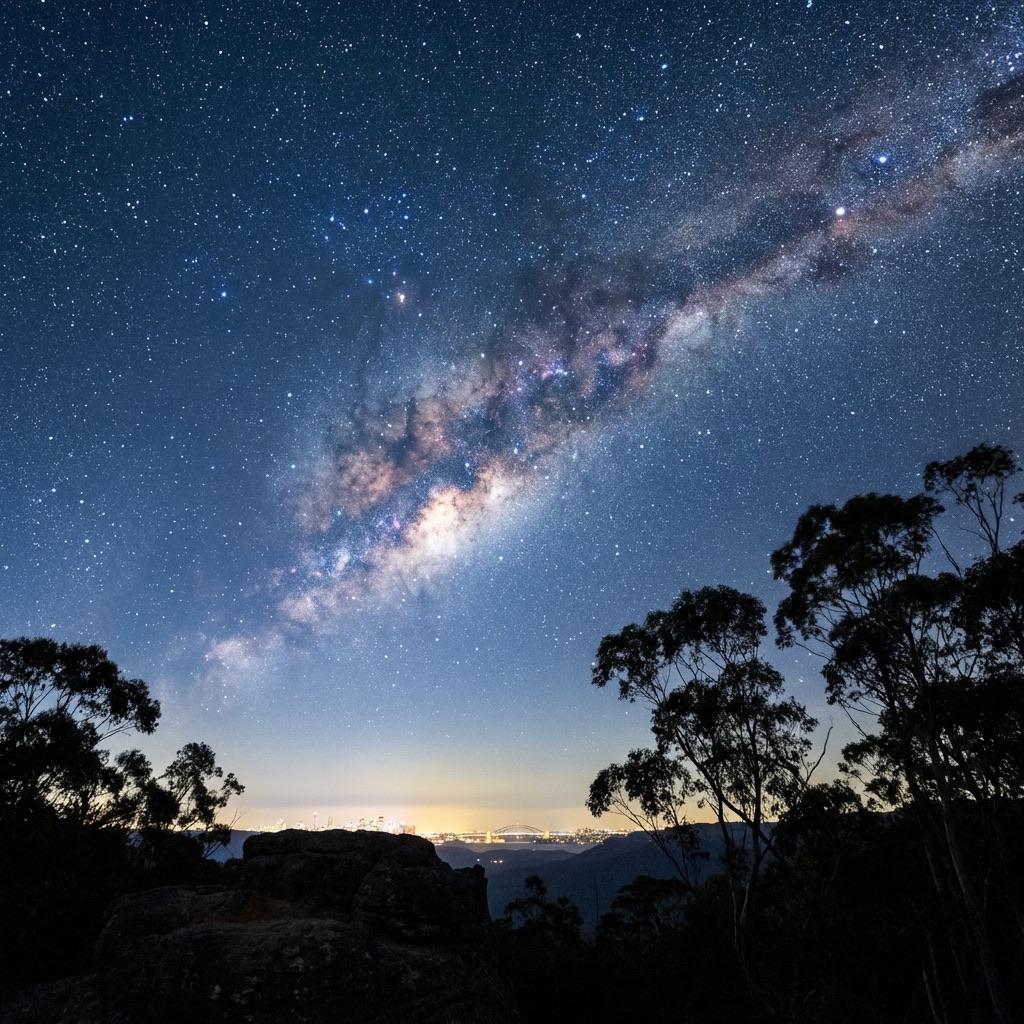
Stargazing Near Sydney: 6 NSW Dark Sky Escapes
Escape the city lights! 6 incredible NSW dark sky spots near Sydney—Warrumbungle, Blue Mountains, and Mudgee. Southern Hemisphere stars at their best.
Stargazing Near Cape Town: 6 South Africa Escapes
Southern African stars! 6 incredible dark sky spots near Cape Town—Sutherland, Cederberg, and the Karoo. Your guide to South Africa's best stars.
Best Places to See the Southern Lights (Aurora Australis)
Explore the best Southern Hemisphere locations for aurora hunting. Learn where to see the Southern Lights in New Zealand, Tasmania, and more.
End of Dossier • Research Complete